
Why AI Needs a Symbolic Model of Your Product, Not Just Your Code
An LLM can generate code, but most of what it 'knows' about your product stays implicit — hidden in weights, scattered across prompts, buried in code, stored in someone's head. GitMir turns that hidden context into an explicit, living graph so AI agents build against the system, not isolated prompts.
AI has a context problem. An LLM can generate code — fluently, in any language, faster than any human. But most of what it "knows" about your product is still implicit. It's hidden in the model's weights, scattered across the prompts you typed last week, buried in the code, and stored in the head of the one engineer who remembers why a thing works the way it does. The model can write the function. It can't see the system the function belongs to.
The short answer to why AI-built features so often break: the model isn't working from a representation of your product — it's working from fragments. The fix isn't a bigger model or a longer prompt window. It's giving AI an explicit, structured model of what the system is — a living graph of entities, relationships, services, rules and dependencies that agents reason against instead of guessing at. That's what GitMir builds.
This article is about that shift: why context, not code generation, is the real bottleneck; what it means to turn a product's implicit knowledge into an explicit symbolic model; and why the next era of AI engineering is agents that build against a model of the system rather than from isolated prompts.
Software is not a pile of files
The first wrong assumption is that a codebase is a collection of files, and that if an AI can read and write files, it can build software. It can't — not reliably — because the file is the least important part of the system. The thing that actually makes a product work is everything between the files.
A real system is a network of:
- business entities — the real nouns the product is about
- data relationships — how those nouns connect and constrain each other
- services — the units that own behavior
- APIs — the contracts other parts depend on
- UI states — what the user can see and do, and when
- events — what happens, and what it triggers
- workflows — the sequences that move work through the system
- rules — the validations and invariants that define "correct"
- dependencies — what can't change without something else changing too
None of that lives in a single file. It lives in the relationships between them. An AI that re-reads your code one prompt at a time sees the file in front of it and nothing of the web around it. So it can write a function that compiles, passes its own little test, and quietly violates an invariant that was enforced three call-stacks away — because that fact wasn't in the file it was looking at. It was in the system, and the system was never given to the model.
Where your product's context actually lives
If you ask where the real knowledge about a mature product is stored, the honest answer is: everywhere except one place you can hand to a model.
- Hidden in weights. The LLM has absorbed a vast prior about how software is usually written — but nothing specific about how your product is actually wired. It pattern-matches to the average, not to you.
- Scattered across prompts. Each chat re-establishes a little context and then throws it away. Nothing accumulates. The tenth prompt is as ignorant of the architecture as the first.
- Buried in code. The codebase is the only complete specification of the system — but it's written for a machine to execute, not for anyone (human or model) to understand. Intent is implicit; you have to reverse-engineer it every time.
- Stored in someone's head. The rest is tribal knowledge: the reason a field is nullable, the customer that one special case exists for, the migration nobody dares to touch. It's real, load-bearing context, and it's unwritten.
This is the gap. The model is asked to change a system whose actual shape is distributed across four places it can't fully read. So it fills the gaps with plausible invention — and plausible-but-wrong is exactly how AI hallucinates code that looks right and breaks things.
Why a correct-looking feature still breaks the system
Here's the failure mode in one sentence: AI can build a feature that looks correct in isolation and still break the system around it.
It happens because "correct" only means something relative to the whole. A new endpoint that returns the right shape can still bypass the one place authorization was enforced. A form that saves cleanly can still write a value that another service assumed could never be null. A refactor that makes one module elegant can quietly sever a dependency two modules over. Each change is locally reasonable and globally wrong — and the model had no way to know, because it never had the global picture.
You can't prompt your way out of this. A longer prompt is still a flat description of a networked reality. What's missing isn't more tokens. It's structure: a representation that encodes not just the parts but the edges between them — the relationships, contracts and dependencies that decide whether a change is safe.
From implicit context to an explicit, living graph
This is what we're building with GitMir. We take the invisible context behind a product and turn it into an explicit, living graph — not just the code, but a structured model of what the system is, how its parts connect, and what each change can affect.
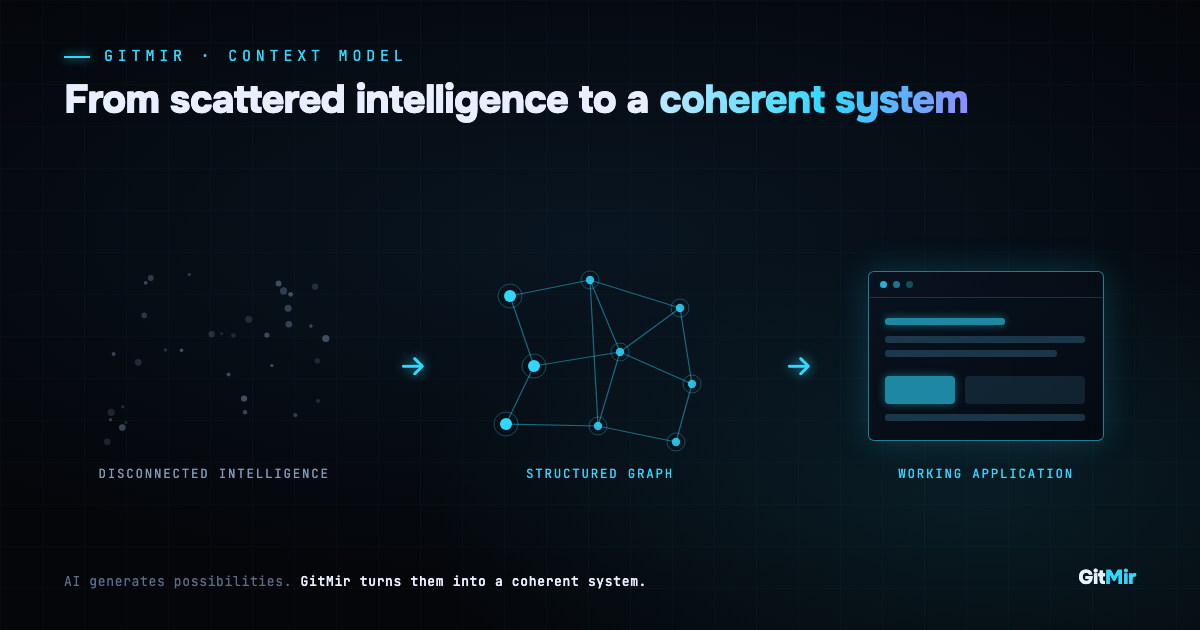
Concretely, GitMir reconstructs the product as a 28-dimensional model — entities and relationships, business logic and rules, data flows, API contracts, UI components and states, events, workflows, roles and permissions, dependencies, and more. Each dimension is a different lens on the same system, and the edges between them are first-class: the model doesn't just list a rule, it knows what that rule touches.
The result is a description that is structured, machine-readable, and independent of any single file. Ask "what breaks if this field changes type?" and the graph can answer — because the dependency is a node-to-node edge, not a fact you have to rediscover by reading. That's the difference between a pile of files and a model of a system.
Agents that work from the system, not from prompts
Once the model exists, the way AI works changes completely.
Agents no longer start from a blank, isolated prompt and a guess about the architecture. They work from the system. Before an agent writes anything, GitMir assembles the exact slice of the model that change depends on — the relevant entities, the rules that constrain them, the contracts it must honor, the dependents it could affect — and hands the agent that, deterministically, instead of hoping the right context happened to be pasted in.
That changes three things at once:
- Accuracy. The agent isn't inventing the shape of the system; it's reading it. There's far less to hallucinate when the structure is given, not guessed.
- Cost. Precise context means you stop re-sending the whole world on every call. A structured pipeline assembles only what each task needs, which is most of why GitMir targets up to 15× fewer tokens than ad-hoc prompting.
- Safety. Because the model knows what each change can affect, a change can be checked against the rest of the product before it ships — not discovered in production.
The agent stops being a fast typist with amnesia and becomes something closer to an engineer who actually knows the codebase.
Neuro-symbolic: making possibilities coherent
There's a name for this combination. Pairing the generative power of neural models with an explicit, structured, symbolic representation of a domain is the core idea behind neuro-symbolic AI — the bet that the most capable systems won't be pure pattern-matchers or pure logic engines, but both, working together.
That's exactly the division of labor here. The neural half — the LLM — is brilliant at generating possibilities: code, options, candidate designs. The symbolic half — the product graph — is what makes those possibilities cohere. One proposes; the other constrains and connects. Neither is sufficient alone. A model with no structure invents; a structure with no model can't build.
So the slogan is precise, not poetic: AI generates possibilities. GitMir turns them into a coherent system.
The shift that's coming
We think this is the direction the whole field is moving. For two years the story has been "AI can write code." The next story is bigger and more useful: AI will build against a symbolic model of the product — a shared, explicit representation of the system that both humans and agents reason over.
When that's in place, the cloud of disconnected intelligence resolves into something structured. Nodes. Edges. Logic. Dependencies. And from that graph, a working application doesn't get prompted into existence one risky guess at a time — it gets generated against a model of what the system is supposed to be. That's not a faster autocomplete. It's a different relationship between AI and software: from generating fragments to building coherent systems.
That's the layer GitMir is building — the explicit model that turns AI's raw generative power into a product that actually holds together.
See it on your own numbers
GitMir gives you visual architecture, reusable components and up to 15× fewer LLM tokens. Try the visual IDE for Claude Code free, or estimate your savings first.
Start free in GitMir IDE → Calculate your ROI →Frequently asked questions
Why does AI write code that looks correct but breaks the system?
Because "correct" is only meaningful relative to the whole system, and the model never sees the whole. An LLM working from isolated files or prompts can't know that the function it's editing is the only place a rule is enforced, or that a field another service depends on can't be null — those facts live in the relationships between files, not in any one file. Give the AI an explicit model of the product (entities, rules, contracts, dependencies) and most of that class of error disappears, because the structure is read rather than guessed.
What is a symbolic (or neuro-symbolic) model of a product?
It's an explicit, structured, machine-readable representation of what the system is — its entities, relationships, business logic, data flows, APIs, UI states, events, workflows, rules and dependencies — as opposed to the raw code. Neuro-symbolic AI pairs that symbolic structure with a neural model (the LLM): the LLM generates possibilities, and the symbolic model constrains and connects them so the result is coherent. GitMir builds this as a 28-dimensional graph of your product.
How is this different from just giving the AI more context in the prompt?
A longer prompt is still a flat description of a networked reality, and it's thrown away after each chat. A model is structured and persistent: dependencies are edges you can query ("what breaks if this changes?"), not facts you re-discover by reading. Instead of pasting more text and hoping the right context is in there, GitMir deterministically assembles the exact slice of the system each task needs — which is also why it uses far fewer tokens.
Does this replace the LLM?
No — it makes the LLM far more useful. The neural model is still what generates the code and the options; the symbolic product model is what tells it the truth about your system and checks the result against the rest of the product. One proposes, the other makes it cohere. You need both.

Related articles
The Laptop Did Not Just Change. The AI Development Model Changed.
NVIDIA's Spark and the AI PC signal a shift: AI agents are moving onto the machine — always-on, local, next to your code. Why that makes architectural visibility non-negotiable.
How to Migrate Legacy Software with AI (Without a Blind Rewrite)
Most legacy migrations fail because nobody fully understands the system being moved. The fix isn't translating code — it's capturing the product as a 28-dimensional model first, so AI can re-platform and refactor it with real context.
GenAI Is Entering Its Performance Review
The AI conversation is maturing from "AI will take your job" to "where's the real business value?" Why generation alone isn't enough — and why the future is human-first, visible AI.