
GenAI Is Entering Its Performance Review
The AI conversation is maturing from "AI will take your job" to "where's the real business value?" Why generation alone isn't enough — and why the future is human-first, visible AI.
For the last two years, the dominant story was simple:
AI is coming for your job.
It was repeated everywhere. In boardrooms. On LinkedIn. In investor decks. In product launches. In every second "future of work" post.
The conversation is changing now. Not because AI disappeared, or adoption stalled, or the technology turned out to be weak. It's changing because companies finally started asking a more grown-up question:
Where is the real business value?
From "AI Will Take Your Job" to "Where's the Value?"
Not the demo value. Not the viral value. Not the "look what I built in 30 seconds" value.
Real value.
Can this system be governed? Can it scale? Can it cut cost without quietly creating new risk? Can it sharpen a decision? Can it be trusted in production? And can a company actually explain what the AI built for it?
This is where the hype cycle gets interesting. Gartner's own Hype Cycle for generative AI shows the technology moving past the Peak of Inflated Expectations, with the business focus shifting away from excitement around foundation models and toward the use cases that actually drive ROI.
Why GenAI Projects Stall After the Proof of Concept
A striking share of GenAI projects never make it past proof of concept. The reasons are mundane and recurring: poor data quality, weak risk controls, costs that keep climbing, and value nobody can point to. Gartner predicted that at least 30% of generative AI projects would be abandoned after proof of concept by the end of 2025 — and more recent Gartner analysis from January 2026 puts that number closer to 50%.
That trend matters.
It doesn't say AI is useless. It says teams are running into the same wall: generation alone isn't enough. Producing output is easy. Understanding the system behind the output is the hard part.
In Software Development, This Is Especially Visible
AI writes code fast. Sometimes alarmingly fast. But the question that matters isn't:
How fast can we generate code?
It's:
What kind of architecture did we just create?
Where does the business logic live? How does data flow through it? Which modules depend on which? What breaks if you change one process? Who still understands the system after a hundred prompts — and who answers for it when today's working code turns into tomorrow's unmaintainable mess?
Most of the AI coding conversation skips right past this, because generation feels like speed. At scale, though, speed without understanding is just technical debt arriving early.
A prototype can survive chaos. A business system cannot.
You can regenerate a landing page ten times and shrug. An enterprise platform — users, permissions, payments, operations, workflows, integrations, reporting — is not something you manage as a pile of generated text. We went deeper on that gap in how to take a vibe-coded prototype to production.
From Excitement to Responsibility
This is why the market's recent direction matters. The serious conversation has moved past adoption. It's about governance, AI-ready data, semantic foundations, agent sprawl, security incidents, and value you can measure.
The data backs this up, and it keeps pointing at the system underneath the model rather than the model itself:
- AI-ready data. Gartner has predicted that through 2026, organizations will abandon 60% of AI projects that are not supported by AI-ready data — the inputs and structure matter more than the model.
- Semantic foundations. Gartner has warned that a lack of semantic foundations makes AI agents inaccurate and inefficient, driving up wasted spend and governance vulnerabilities. Agents that don't understand the system they operate in fail expensively.
- Agent governance. And on governance specifically, Gartner predicts that more than 40% of agentic AI projects will be canceled by the end of 2027 — enterprises demoting or decommissioning autonomous agents they can no longer control.
So the market is moving from excitement to responsibility. And responsibility needs visibility.
Owning the Output vs. Owning the Logic
When AI builds something humans can't follow, the company doesn't really own the result. It owns an output. Not the logic. Not the structure. Not the architecture. Not the context that ties them together.
That's the core problem we're solving with GitMir. The future of software development isn't "AI writes code and humans hope it works." It's visual, structured, editable, controlled AI software creation.
What "Creating Software" Actually Means
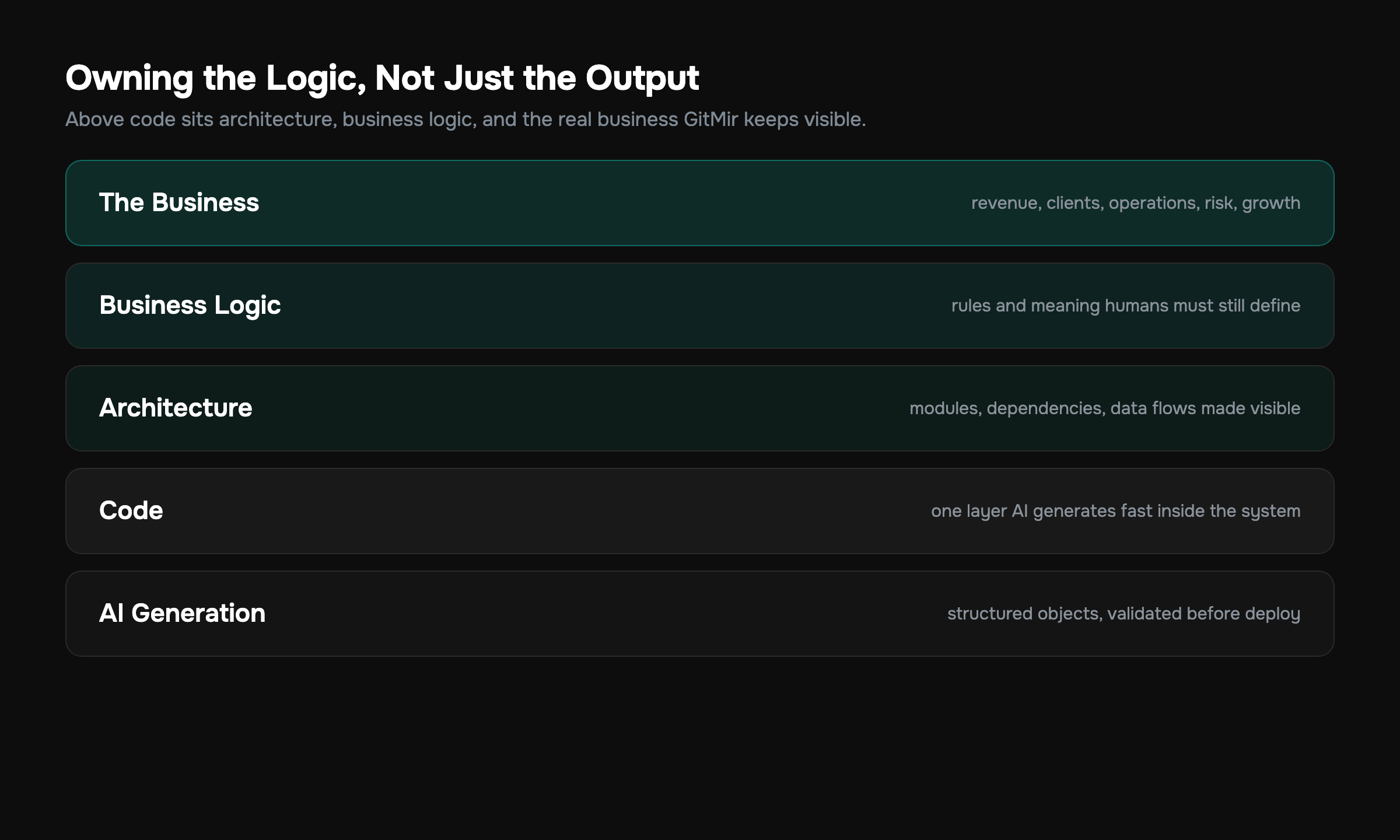
AI should help build systems faster. But people should still see what's being built.
- They should see architecture visually.
- They should see business logic visually.
- They should see data flows visually.
- They should be able to change product logic without losing control.
- They should be able to understand the system before it turns dangerous.
That's the line between generating code and creating software.
Code is one layer. Above it sits architecture. Above that, business logic. And above that, the actual business: revenue, clients, operations, risk, growth.
Change the code without exposing those layers, and the company is now leaning on a black box. That's not transformation.
That is hidden risk with a beautiful interface.
The Next Phase Won't Be Won by More Output
The next phase of AI won't be won by whatever tool generates the most output. It'll be won by systems that make AI output understandable, governable, reusable, and tied to business value.
Why "Humans First" Is the Only Serious Way to Use AI
This is also why "humans first" isn't an anti-AI stance. It's the only serious way to use AI.
It doesn't mean humans hand-crank everything. It means human judgment stays at the center.
AI accelerates execution. It generates options, automates routine work, helps you build faster. But humans define meaning. Humans hold context. Humans make the architectural calls. Humans own the system that results.
Because software isn't just code. It's business logic compiled into an operating system. And if nobody can see that logic, nobody can truly run the business.
GenAI Is Entering Its Performance Review
The question was never whether AI stays. It stays. The question is which AI systems companies will actually trust.
Black-box generators? Or visual, structured, controllable environments where AI works alongside human judgment?
My bet: the next wave of software development won't be AI-first. It'll be human-first AI — AI that helps people build faster and understand deeper at the same time.
The real future isn't more generated code. It's visible intelligence. See what that looks like in practice — explore GitMir or estimate what visibility and reuse save your team.
See it on your own numbers
GitMir gives you visual architecture, reusable components and up to 15× fewer LLM tokens. Try the visual IDE for Claude Code free, or estimate your savings first.
Start free in GitMir IDE → Calculate your ROI →Frequently asked questions
Why are so many generative AI projects abandoned after the proof of concept?
Because a demo proves an output, not a system. Gartner attributes the high abandonment rate to poor data quality, weak risk controls, escalating costs, and unclear business value. Projects stall when teams cannot govern, scale, or trust what they generated, so the proof of concept never becomes a real production system.
What is the difference between generating code and creating software?
Generating code produces text fast; creating software produces a system you can govern. Code is one layer — above it sit architecture, business logic, and the real business. Creating software keeps those layers visible and controllable, so a company owns the logic, not just an opaque output that works today and breaks tomorrow.
What does "human-first AI" actually mean?
Human-first AI keeps human judgment at the center while AI accelerates execution. It does not mean people do everything by hand. AI generates options, automates routine work, and speeds building, but humans still define meaning, understand context, make architectural decisions, and stay responsible for the system that results.
Why is AI-generated code a business risk at scale?
A prototype can survive chaos; a business system cannot. Fast generation without visible architecture creates technical debt — scattered logic, hidden data flows, and modules nobody fully understands after a hundred prompts. At enterprise scale, with users, payments, and integrations, that opacity becomes operational and financial risk hiding behind a polished interface.
How does GitMir help companies stay in control of AI development?
GitMir makes AI-assisted development visual, structured, and editable. You see architecture, business logic, and data flows on screen; AI generates structured objects inside that system; and changes are validated before deploy. The result is software a company actually understands and owns — not a black box it merely operates and hopes works.
Is "humans first" an anti-AI position?
No — it is the only serious way to use AI. Human-first means using AI heavily for speed and automation while keeping people in charge of meaning, architecture, and responsibility. It rejects black-box generation, not AI itself. The goal is visible intelligence: AI that helps you build faster and understand deeper.

Related articles
The Laptop Did Not Just Change. The AI Development Model Changed.
NVIDIA's Spark and the AI PC signal a shift: AI agents are moving onto the machine — always-on, local, next to your code. Why that makes architectural visibility non-negotiable.
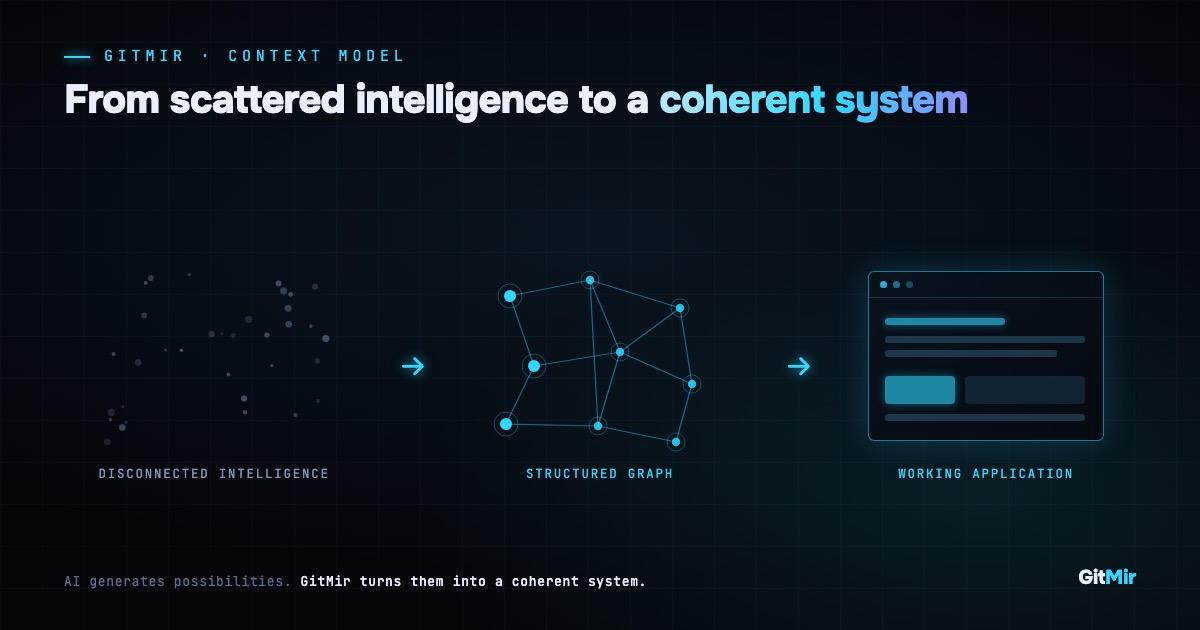
Why AI Needs a Symbolic Model of Your Product, Not Just Your Code
An LLM can generate code, but most of what it 'knows' about your product stays implicit — hidden in weights, scattered across prompts, buried in code, stored in someone's head. GitMir turns that hidden context into an explicit, living graph so AI agents build against the system, not isolated prompts.
How to Migrate Legacy Software with AI (Without a Blind Rewrite)
Most legacy migrations fail because nobody fully understands the system being moved. The fix isn't translating code — it's capturing the product as a 28-dimensional model first, so AI can re-platform and refactor it with real context.