
The Laptop Did Not Just Change. The AI Development Model Changed.
NVIDIA's Spark and the AI PC signal a shift: AI agents are moving onto the machine — always-on, local, next to your code. Why that makes architectural visibility non-negotiable.
For 30 years, the laptop was basically one idea. A screen, a keyboard, a processor, some storage, a few applications. And a human sitting in front of it, typing commands.
Then cloud changed the backend. SaaS changed distribution. AI changed the interface.
Now something bigger is starting: AI is moving back onto the machine.
Cloud Changed the Backend. AI Changed the Interface. Now AI Moves to the Machine.
NVIDIA's RTX Spark announcement is not just another hardware launch. It signals that the next generation of personal computers won't be built only around apps, browsers, and files. They'll be built around local AI agents.
Not an agent that only answers questions. An agent that lives inside the machine, works with local context, and runs close to the code, data, files, tools, and workflows it touches.
That is a very different world, and it's not a fringe trend. Gartner forecasts that AI PCs will make up a rapidly growing share of new shipments, on the order of 40% or more of PCs sold in 2025, as on-device AI moves from novelty to default.
Why Cloud-First AI Development Hits a Wall
For the last two years, most AI development has been cloud-first. You open a chat. You send a prompt. The model gives you text, you copy it somewhere, you test, you fix, you send another prompt. The context slowly breaks. The architecture slowly disappears. And the developer turns into a translator sitting between the AI output and the real product.
That loop is fine for prototypes. It starts breaking the moment the product gets serious. We unpacked that exact gap in how to take a vibe-coded prototype to production.
What "Serious Software" Actually Contains
Serious software is not just generated code. It has architecture, business logic, data flows, permissions, integrations, events, states, reports, users, revenue, operational risk.
When AI only sees fragments, fragments are exactly what it generates.
Speed without the full picture is not velocity. It is faster fragmentation.
Why Local AI Agents Change the Relationship
That's why local AI agents matter so much. When the agent lives on the machine, the relationship changes:
- It can potentially work closer to the full project context.
- It can observe the file system.
- It can interact with development tools.
- It can reason over local repositories.
- It can run tasks continuously.
- It can assist not only in generation, but in monitoring, refactoring, checking, and explaining.
That's the gap between a chat window and a genuine AI development agent.
The Danger: More Local AI Power Can Mean Faster Chaos
There's a catch. More local AI power doesn't automatically produce better software. It can just as easily produce faster chaos.
An agent that's always on, always editing, always suggesting, always generating makes visibility the whole ballgame:
- What did the agent change?
- Why did it change it?
- Which business process is affected?
- Which module depends on this logic?
- Which data flow changed?
- Which architecture decision was silently introduced?
- Can the human still understand the system?
That is the real problem.
The Real Question Isn't the Chip — It's the Architecture Around the Agent
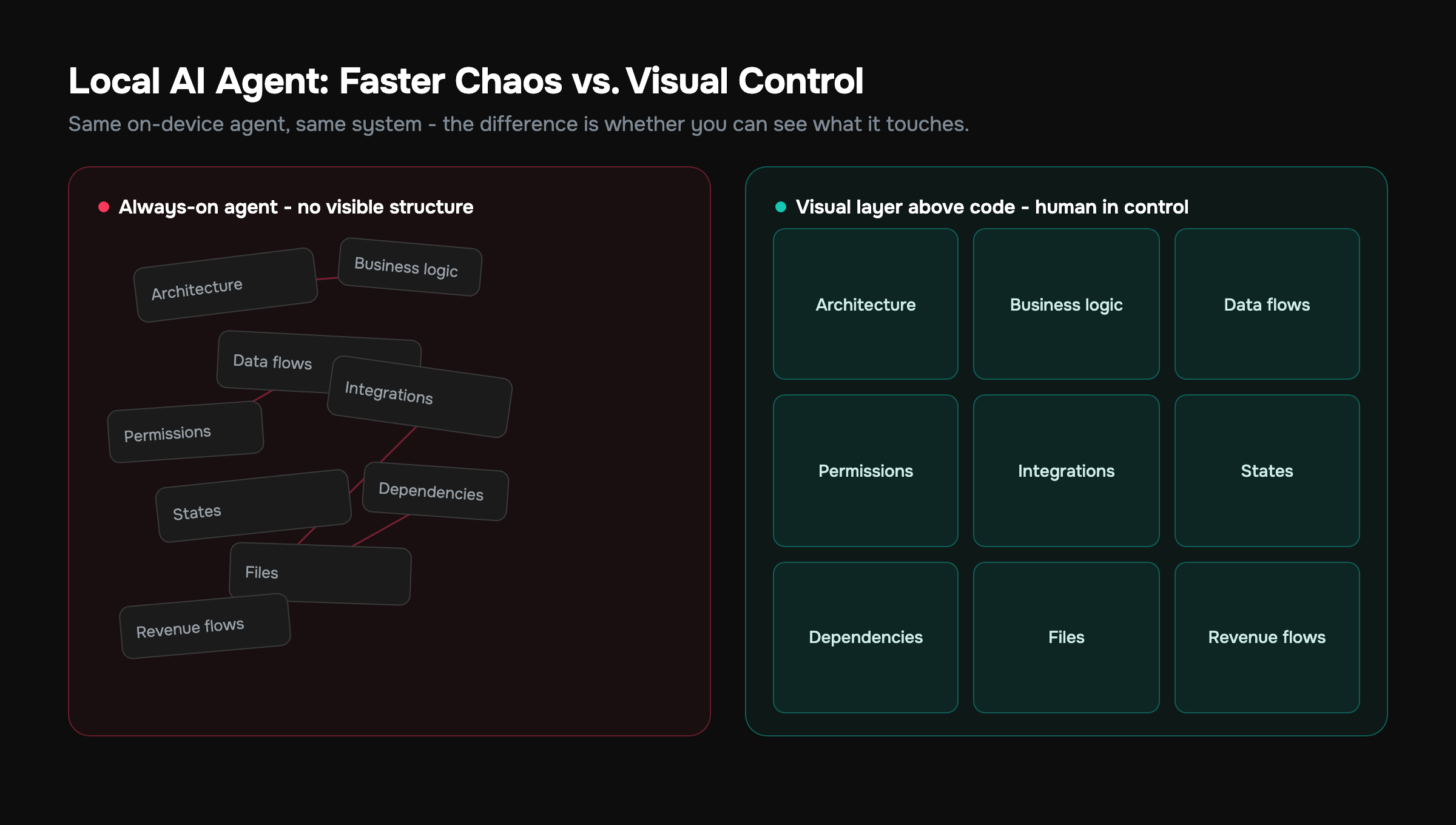
The future of AI development won't be decided by whoever has the fastest chip. It'll be decided by whoever controls the architecture around the agent.
RTX Spark points at a future where AI work gets local, persistent, and much closer to the developer's real environment. But local intelligence still needs structure.
Without structure, an agent becomes just a faster autocomplete with more power. With structure, it becomes a real development partner.
Where GitMir Fits: A Visual Layer Above Code
This is exactly where GitMir's vision gets more relevant, not less. GitMir is built on one idea: AI-generated software should not disappear into text code that only a few people can read.
- The architecture should be visible.
- The business logic should be visible.
- The data flows should be visible.
- The product structure should be editable.
- The human should stay in control.
AI can generate, but humans still have to understand it. AI can accelerate, but the company still has to govern it. AI can automate tasks, but the system still has to stay transparent. Holding that balance is the entire job of AI development for CTOs.
The next generation of AI development needs more than prompts. It needs a visual layer above code — a place where local agents, cloud models, developers, founders, product managers, and business teams all see what's happening inside the product.
When Agents Move Onto the Machine, They Join the Product Lifecycle
Once AI agents move onto the machine, they sit much closer to the source of truth. They stop generating isolated snippets. They start participating in the lifecycle of the product.
So we need better ways to control them. Not with fear. With architecture. Not by blocking AI, but by giving it a structured environment where every action can be understood, reviewed, reused, and tied back to business logic. It's the same reason AI breaks codebases when it can't see them.
The AI PC Matters Because the Computer Becomes an Execution Environment for Agents
That's why the AI PC matters. Not because the laptop suddenly got cooler. Because the computer is becoming an execution environment for agents.
And once agents are local, always-on, and wired into our workflows, the biggest question stops being how powerful is the chip? It becomes: can we still see what the agent is doing?
The companies that answer that will define the next era of software development. Not AI coding. Not vibe coding. Not cloud prompts. Visual, structured, controllable AI software creation.
The Development Paradigm Changed
The laptop didn't just change. The development paradigm changed.
If your team is about to park always-on agents next to your codebase, the moment to add a visual, governable layer is before the chaos compounds, not after. See how GitMir keeps AI under control, or estimate what visibility and reuse save your team.
See it on your own numbers
GitMir gives you visual architecture, reusable components and up to 15× fewer LLM tokens. Try the visual IDE for Claude Code free, or estimate your savings first.
Start free in GitMir IDE → Calculate your ROI →Frequently asked questions
What is an AI PC?
An AI PC is a personal computer with dedicated hardware — an NPU or high-end GPU — that runs AI models and agents locally, on-device, instead of only calling the cloud. It enables always-on local agents that work directly with your files, code, and tools, with lower latency and more private context.
Why are local AI agents a big deal for software development?
Because a local agent can see far more context — the file system, repositories, dev tools, and running tasks — than a single pasted prompt. That makes it more capable but also more dangerous: an always-on agent editing your system needs strong visibility and structure so humans still understand what changed and why.
Do local AI agents make software better automatically?
No. More local AI power does not create better software on its own — it can create faster chaos. An always-on agent that constantly edits and generates makes architectural visibility more important, not less. Without structure you get a faster autocomplete; with structure you get a real development partner.
What does GitMir add in a world of local AI agents?
GitMir provides the visual layer above code, making architecture, business logic, and data flows visible and editable so agents — local or cloud — operate inside a structure humans control. Every change can be understood, reviewed, reused, and connected to business logic instead of disappearing into opaque generated text.
Is the AI PC just hyped hardware?
The hardware matters, but the real shift is that the computer becomes an execution environment for agents — local, persistent, and tied to your workflows. The deciding question is not "how fast is the chip?" but "can we still see what the agent is doing?" The firms that answer that define the next era.
How do you keep always-on AI agents under control?
Not with fear or by blocking AI, but with architecture. Give agents a structured environment where every action is visible, reviewable, reusable, and connected to business logic. Visibility over the system — not raw model power — is what keeps autonomous, local agents from quietly turning your product into a black box.

Related articles
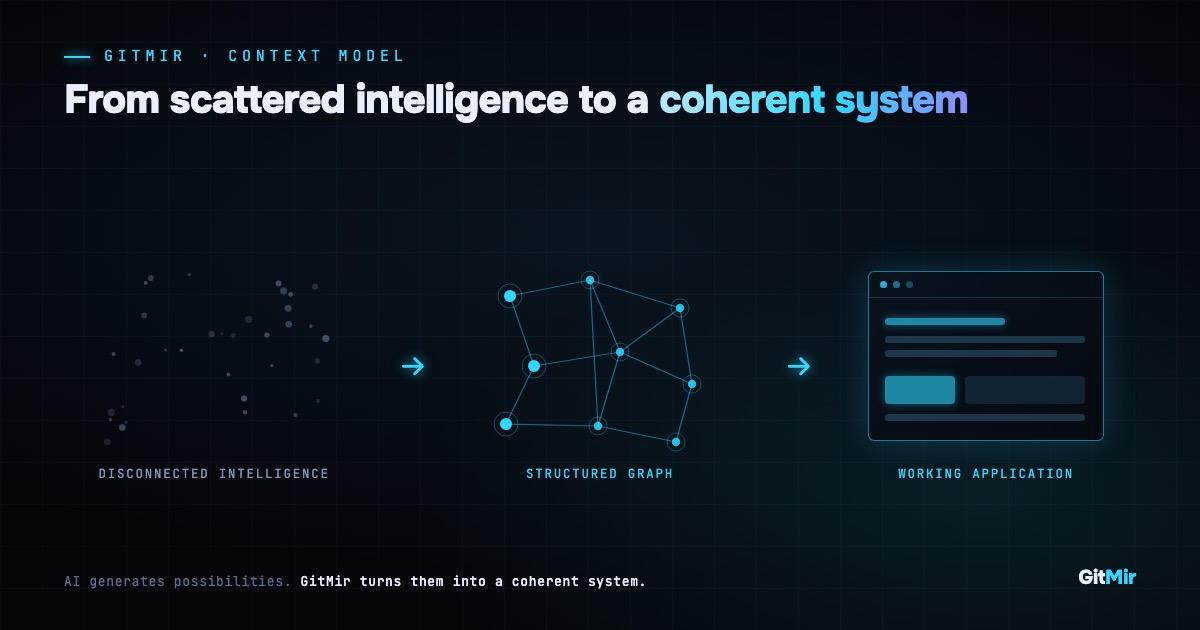
Why AI Needs a Symbolic Model of Your Product, Not Just Your Code
An LLM can generate code, but most of what it 'knows' about your product stays implicit — hidden in weights, scattered across prompts, buried in code, stored in someone's head. GitMir turns that hidden context into an explicit, living graph so AI agents build against the system, not isolated prompts.
How to Migrate Legacy Software with AI (Without a Blind Rewrite)
Most legacy migrations fail because nobody fully understands the system being moved. The fix isn't translating code — it's capturing the product as a 28-dimensional model first, so AI can re-platform and refactor it with real context.
GenAI Is Entering Its Performance Review
The AI conversation is maturing from "AI will take your job" to "where's the real business value?" Why generation alone isn't enough — and why the future is human-first, visible AI.